A face built for reading
Zhong Kui is one of the few figures in Chinese art whose iconography is almost completely standardised. If you have seen one Zhong Kui painting, you can read the next one: the same beard, the same eyes, the same robe, the same objects in the same hands.
That standardisation is the point. The image is a functional object — a sign on a door — and a sign that has to be recognised from across a courtyard at night cannot afford subtlety. Every attribute is doing a job.
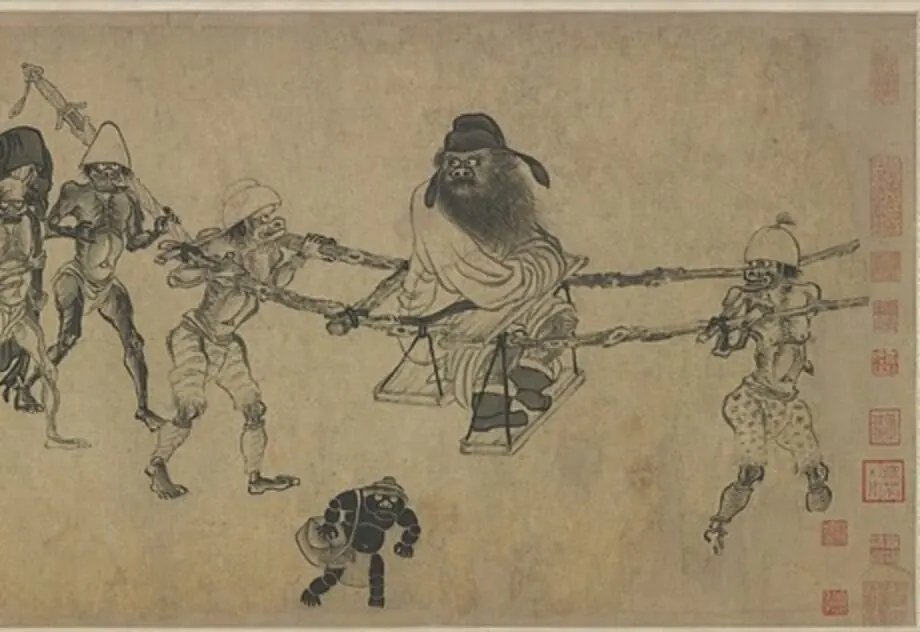
The face
- Bulging eyes. The most important feature. They are not angry so much as unblinking: the look of someone who sees what other people cannot.
- A thick black beard, usually curling, sometimes reaching the chest. It signals age and masculinity, and it makes the silhouette unmistakable.
- A broad, flat nose and heavy brows. The ugliness from the story is preserved deliberately. He was rejected for his face, and the face is what makes him effective against ghosts.
- An official's hat — the winged cap of a Tang civil servant — or, in later popular prints, a scholar's headband.
The robe
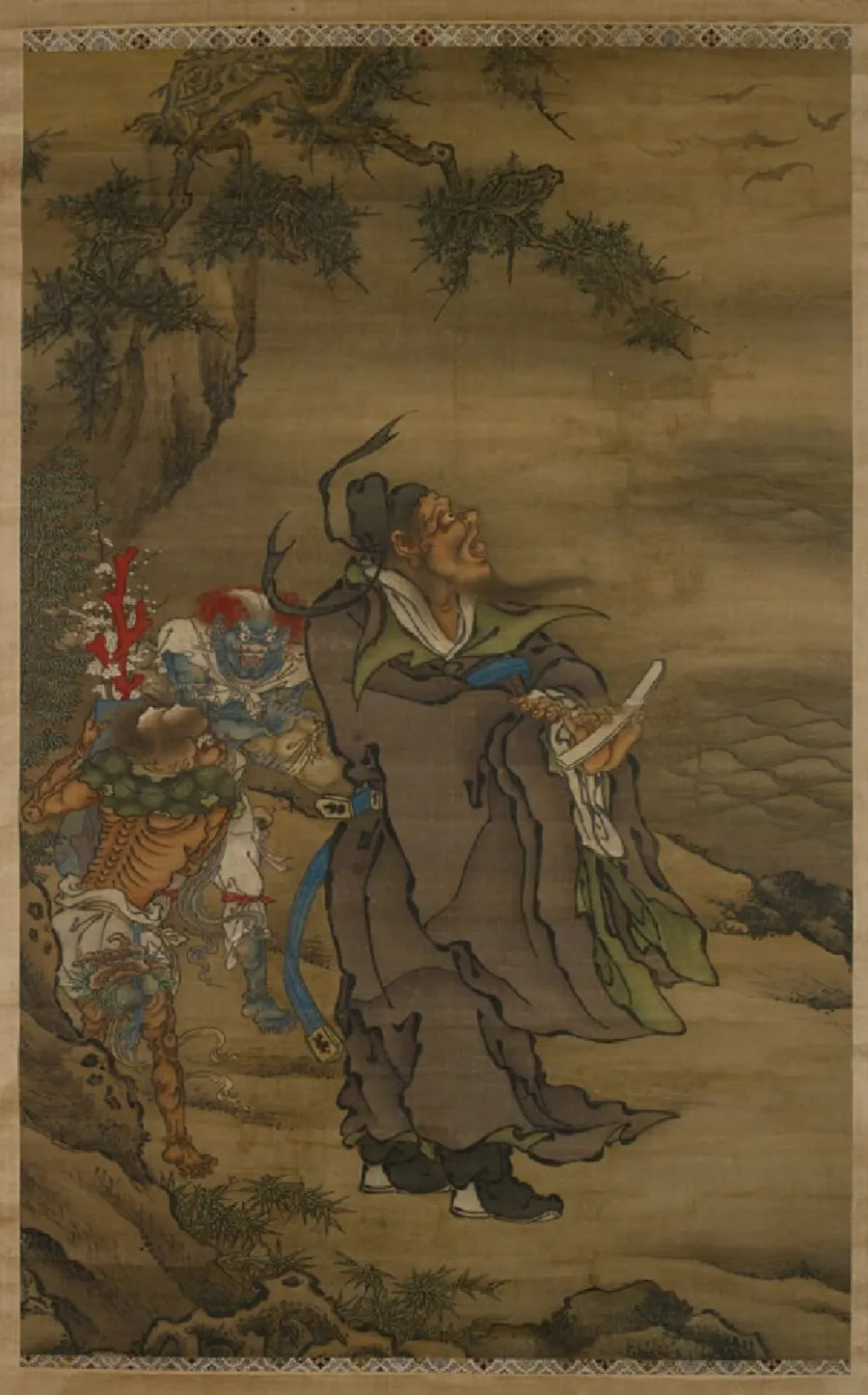
Zhong Kui wears the dress of a civil official: a long robe, a belt, sometimes the buzi rank badge of the Ming and Qing. This is the single most important thing to understand about him. He is not a warrior saint. He is a magistrate with a sword.
The robe also explains the comedy. A fat bureaucrat in formal dress chasing a demon around a courtyard is funny, and the tradition knows it. Zhong Kui paintings are rarely solemn; many are deliberately grotesque.
The objects
- The sword. An instrument of office rather than a weapon of war. In the earliest versions he carries it point-down, as an authority symbol; in later prints it is raised.
- The bat. A small bat, often flying near his head or held in his hand. The pun is the whole reason: fu (蝠, bat) sounds like fu (福, fortune). The bat converts the ghost-catcher into a bringer of good luck.
- The fan or umbrella. In some regional versions he carries a broken fan or an umbrella — objects of travel and of the scholar, and, in the Marries Off His Sister scrolls, props for a journey.
- The demon. Almost always present: small, naked, dark, gripped by the hair or the ankle. The scale difference is the message.
- The tiger. In some traditions he rides one. The final shot of the 2026 gameplay demo uses exactly this image.
Opera and the mask
Zhong Kui's stage face is the most extreme version of the iconography. In Peking opera and regional forms, the role is played with a painted face rather than a mask:
- a red forehead mark, sometimes a stylised shou (longevity) character
- a red nose
- heavy black brows
- ears painted to look like bat wings
The effect is a face that reads as a mask even in close-up, which is why the Zhong Kui role is one of the few where an actor's own expression is irrelevant.
What the game seems to keep
The fifteen-minute gameplay demo borrows selectively. The playable character wears white robes, not official red, and fights with a sword — the attribute most associated with Zhong Kui. The talismans and seal-like effects are the bureaucratic reading of the character made mechanical.
What is not yet visible is the face. Zhong Kui himself appears, if at all, at the very end of the demo, on a tiger, in the dark. If the Du Ping theory is right, the game is deliberately keeping the icon off-screen — saving the bulging eyes, the beard and the hat for a reveal.
How to look at a Zhong Kui picture
Four questions, in order:
- Where is the bat? If it is there, the picture is a New Year print meant to bring luck, not just protection.
- What is in his other hand? A sword means the standard demon queller; a fan or umbrella suggests a narrative scene, often the sister story.
- Is there a demon? If yes, the picture is a demonstration of his office. If no, it is a portrait — a figure to be displayed rather than a job being done.
- What is he wearing? Tang official dress places the image earlier; Ming or Qing rank badges place it later, and usually mean a popular print rather than a court painting.
For the story these images come from, read the legend and its sources. For how the customs work in practice, see folk customs.