The door picture
For most of the last thousand years, Zhong Kui lived on doors. On New Year's Eve, households pasted his portrait on the outer gate — a fierce face with bulging eyes, a black beard, an official's hat, a sword in one hand — and left it there through the festival. It was cheap, it was printed in multiples, and it was the most widespread form of household protection in China.
The logic of the door picture is not worship. Nobody prayed to Zhong Kui for rain, children or a good harvest. The picture is a notice: a senior officer of the underworld lives here, and trespassing spirits should look elsewhere. He is closer to a guard dog than to a god.
Zhong Kui shares the door with older guardians — the divine generals Shenshu and Yulei, the martial god Guan Yu, the pair Qin Shubao and Yuchi Jingde — and different regions, and different centuries, put different combinations on the same door.
The Five Poisons and Duanwu
The fifth day of the fifth lunar month, Duanwu, is the other date in Zhong Kui's calendar. It is the festival of midsummer heat, when snakes, scorpions, centipedes, toads and spiders are said to be at their most dangerous — the "Five Poisons".
In parts of central and southern China, Zhong Kui's picture goes up again for Duanwu, sometimes with the Five Poisons drawn under his foot or in his hand. The point is the same as at New Year but seasonal: the danger has changed from ghosts to vermin, and the same officer handles both.
The pairing is a good illustration of how Chinese folk religion actually works. A figure with no scripture and no church stays alive by being useful in more than one context.
The dance
In several regions, Zhong Kui is not only a picture but a performance. Dancers in his mask and robe — sometimes with a sword, sometimes with a fan — walk through villages at festival time, entering courtyards to "catch" the ghosts that have been troubling a household.
The best-known version is the Zhong Kui dance of the Huizhou region in Anhui, where the performance is part of New Year ritual and the dancer's movements are built around the same beats as opera: the entrance, the search, the catch, the exit.
Watching a Zhong Kui dance tells you something the paintings cannot: he is played as a civil official, not a warrior. The steps are formal, almost bureaucratic. The comedy and the terror are both in the contrast between a fat, ugly bureaucrat and the things he is arresting.
Temples and places
Zhong Kui has no national temple network, but he has local shrines, and they cluster around two kinds of place: mountains associated with his legend and towns that adopted him as a protector.
- The Zhongnan Mountains in Shaanxi are traditionally given as his home. The legend says he came from there, and the region has kept the association.
- Mount Furong in Changsha, Hunan, has a Zhong Kui temple that is still active, with a festival on his traditional birthday.
- Huizhou in Anhui keeps the dance tradition alive as an intangible cultural heritage item.
None of these places claims to hold his remains, because the story is not that kind of story. What they hold is a practice.
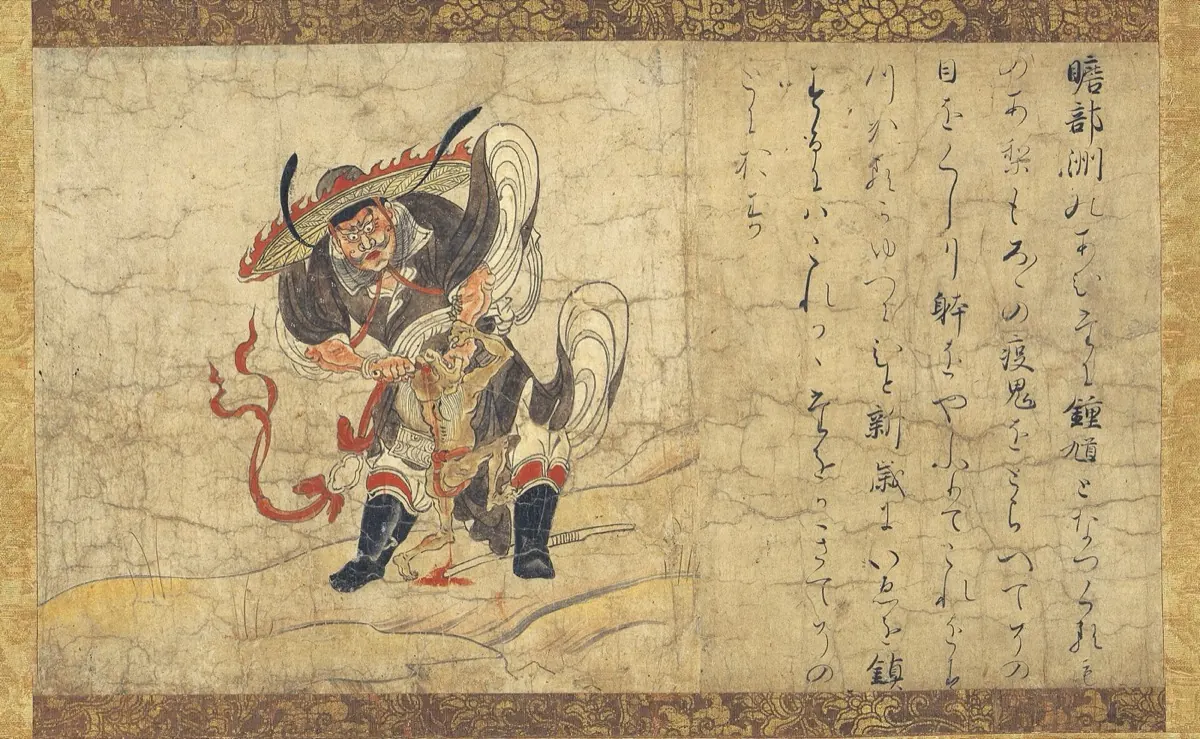
Japan: Shōki
Zhong Kui travelled. In Japan he is Shōki, the demon queller, and he arrived early — by the medieval period he was already being painted and displayed, and by the Edo period he was a standard subject for screens, hanging scrolls and the flags flown on Children's Day.
Japanese Shōki keeps the sword, the beard and the official's robe, but the tone shifts: he is often shown relaxed, sitting, or with a fan, and the paintings are more about the figure's strangeness than about protection. The image survived the crossing better than the ritual did.
Why any of this matters for the game
Game Science has a thousand years of visual and ritual material to draw on, and the trailers suggest a game that treats the folklore as a system rather than decoration: charms that work like paperwork, spirits with names and jobs, a protagonist who is employed rather than chosen.
Whether the game uses the door picture, the dance or the Duanwu tradition is something only the finished game will show. But the material is there, and it is much stranger than the usual Western idea of a ghost hunter.
For the visual vocabulary itself, see reading the image.